Buyer's guide
Wool, felt or linen? Choosing a sauna hat material
October 31, 2026 · 6 min read
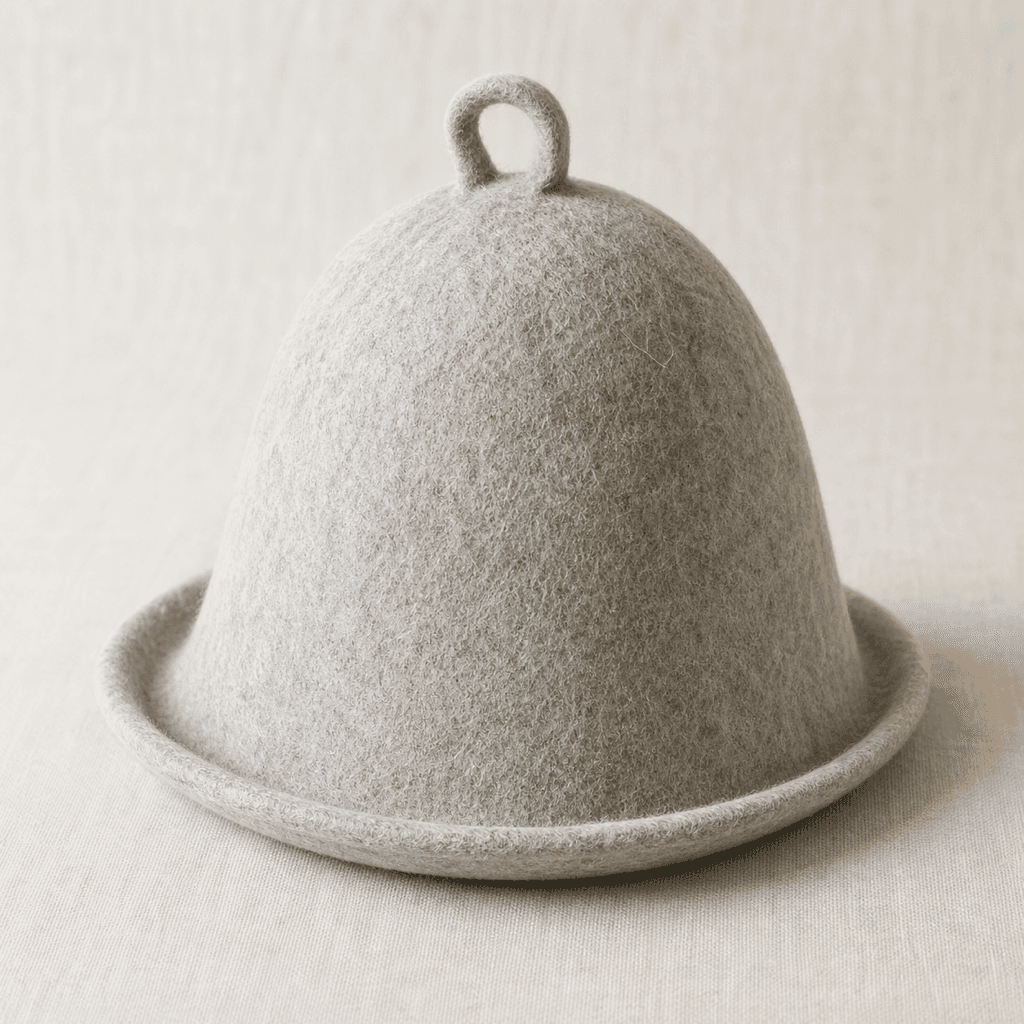
Search for a sauna hat and you'll find a small, confusing aisle: thick felt bells, airy linen caps, terry-cloth beanies, and a few shiny things of unclear origin. They all go on your head. They do not all do the same job.
Here's a calm, honest walk through the four materials you'll actually meet, what each one is good at, and where each falls short, so you can pick the one that matches how hot, how long and how often you sauna.
First, a quick word on 'wool' vs 'felt'
These two get used as if they were rivals, but they aren't. Wool is the fiber; felt is what you get when wool fibers are worked with moisture, warmth and pressure until they lock together into a dense, solid fabric. A proper sauna hat is wool felt: no weaving, no knitting, just matted fiber thick enough to stand up on its own.
The word to watch is 'felt' on its own. Plenty of craft felt is made from polyester or acrylic, and it looks almost identical on a product page. If a listing says felt but never says 100% wool, assume it isn't.
100% wool felt: the traditional choice, for good reason
Wool felt is what Finnish and banya sauna-goers have worn for generations, and the reasons are simple physics. A thick layer of felt holds a pocket of still, cooler air around your head and slows down how quickly the sauna's hottest air reaches your scalp. Wool also handles moisture gracefully, staying comfortable while damp, and naturally resists odor, so most care is just hanging it up to dry.
It's also the safer fiber near a stove. Wool is naturally flame-resistant: it tends to char and self-extinguish rather than melt. Thickness matters as much as fiber, and around 8 mm of dense felt is the sweet spot (our buyer's guide explains why).
The honest downsides: wool felt is warmer and heavier on the head than linen, it takes longer to dry, and it needs gentle care. No machine washing, no tumble dryer. If those trade-offs are fine with you, nothing else insulates as well.
Linen: light, airy, and best when the heat is gentler
Linen sauna hats are thin, breathable and pleasant to wear. They dry quickly, wash easily and feel cool against the skin. For an infrared cabin, a milder sauna, or short sessions where you mostly want to keep the sun-on-the-scalp feeling off and your hair a little protected, linen is a perfectly sensible pick.
Where it falls short is insulation. A single layer of woven linen is a thin barrier, so in a hot Finnish sauna, at 80–90°C with a few ladles of löyly, it slows the heat far less than thick felt does. Think of linen as a sun hat for the sauna, and wool felt as the proper heat shield.
Cotton and terry: comfortable, but it holds the wet
Terry-cloth caps and cotton beanies are soft, cheap and easy to throw in the wash. The problem is what cotton does with water: it absorbs sweat and steam readily and then stays damp, and a damp layer against your head isn't doing much insulating. In a steamy round it can end up feeling heavy and warm rather than protective.
If you already wrap a towel around your head, a terry cap is a tidier version of the same thing, and we compare the two more fully in sauna hat vs a towel. It's a step up from nothing, not a substitute for felt.
Synthetics and blends: the one to skip
Polyester felt, acrylic knits and 'wool-blend' hats are the inexpensive end of the marketplace, and they're the one category we'd steer you away from. Synthetic fibers insulate poorly for their thickness, don't breathe well, and trap sweat. More importantly, many synthetics soften or melt with enough heat rather than charring, which is not a quality you want sitting near a hot stove.
A blend dilutes the problem rather than solving it. If you want to check a hat you already own, the classic burn test helps: real wool smells like burnt hair and crumbles to ash, while synthetic fiber smells chemical and melts into a hard bead.
The comparison at a glance
The four materials, side by side:
- 100% wool felt: best insulation for hot traditional saunas; breathes, resists odor, chars rather than melts. Warmer and heavier, slower to dry, hand-wash only.
- Linen: light, airy, quick-drying and easy to wash. Fine for infrared, milder heat and short sessions; insulates much less in a hot sauna.
- Cotton / terry: soft and machine-washable. Soaks up sweat and steam and stays damp, so it protects less as the session goes on.
- Synthetic / blends: cheapest. Insulates poorly, traps sweat, and can soften or melt near heat. Best avoided.
So which should you choose?
If you sauna hot and traditional, in a wood-fired or electric Finnish sauna, a banya, or anywhere people throw löyly, choose 100% wool felt around 8 mm thick. If your sessions are mostly infrared or gentle, linen is a fine, breezy alternative. Cotton is a stopgap, and synthetics are a skip.
That's why we make only one kind: hand-finished 8 mm wool felt, one size (about 54–61 cm), in seven colorways named in Finnish. One material, chosen for the hottest bench in the room.
Common questions
What is the best material for a sauna hat?
Are linen sauna hats any good?
What's the difference between wool and felt?
Can I wear a cotton beanie in the sauna?
Ready for a cooler head?
Meet the hats